RxMx

Redesigning a digital health platform that helps healthcare providers safely manage complex medications and improve patient care.

RxMx is a healthcare technology platform that helps providers safely manage complex medications throughout the patient treatment journey. I redesigned the provider portal and companion patient experience to improve patient tracking, streamline clinical workflows, and strengthen communication between patients and healthcare teams.

My Role
  • Senior Product Designer
Skills
  • Product Strategy
  • UX Research
  • Healthcare UX
  • Interaction Design
  • Prototyping
  • Accessibility (WCAG)
Impact
80%
Reduction time to add and locate patients
30%
Increased patient engagement

The Problem

Healthcare providers lacked visibility into the patient journey

Doctors and care teams had no easy way to track where patients were in the medication onboarding process for Mayzent™ and Gilenya™. Without clear status tracking, it was difficult to monitor progress and identify patients who required follow-up.

Managing patients was inefficient

The existing portal made it difficult to add new patients, filter patient lists, or quickly identify which medication a patient was taking. Providers spent unnecessary time navigating the system instead of focusing on patient care.

Patients had limited engagement

Patients struggled to stay connected throughout treatment. Reporting medication progress, finding nearby testing facilities, and completing onboarding required multiple disconnected steps, creating a poor overall experience.
The Solution

Designed a stage-based patient management portal

Doctors and care teams had no easy way to track where patients were in the medication onboarding process for Mayzent™ and Gilenya™. Without clear status tracking, it was difficult to monitor progress and identify patients who required follow-up.

Simplified provider workflows

Introduced an Add Patient workflow, medication filters, and improved navigation, making it faster for providers to onboard patients and manage large patient lists.

Created a companion patient experience

Designed a mobile experience that allowed patients to track medication progress, receive onboarding instructions, find nearby testing facilities, and communicate updates directly with their healthcare providers.

Prioritized accessibility and trust

Applied accessibility best practices (including ADA/WCAG considerations) and used patient-centered language to create an experience that was inclusive, easy to understand, and appropriate for sensitive healthcare information.

The research

Information architecture & User flows

I mapped the end-to-end workflows for both healthcare providers and patients to better understand how they navigated the platform. This helped identify unnecessary complexity, organize content into a more intuitive structure, and establish clear paths for key tasks such as onboarding, medication tracking, and patient management.

Stakeholder & User interviews

I conducted interviews with healthcare providers and internal stakeholders to understand their daily workflows, frustrations, and priorities. These conversations uncovered usability issues in the existing portal and helped prioritize improvements that would reduce administrative effort and streamline patient management.

“I just feel like there’s so many steps just to add a patient, I remember when I first used our portal and I couldn’t even find the button to add someone”

“I just want to get in to check my patients easily and get out”

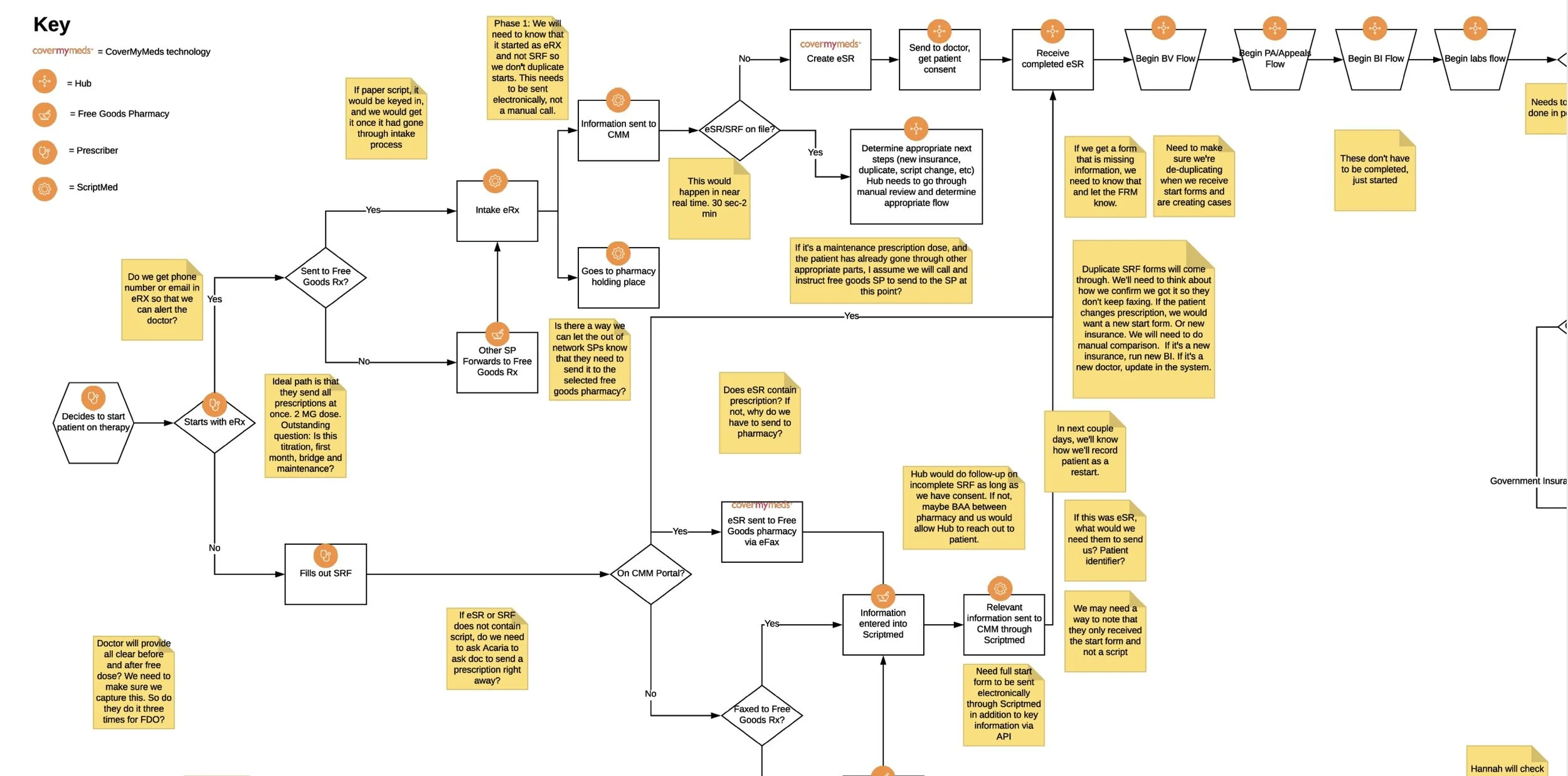
RxMx user flow diagram mapping the prescriber journey from starting a patient on therapy through eRx intake, CoverMyMeds submission, pharmacy routing, and downstream benefit verification, prior authorization, and labs flows, annotated with open questions.

The Design

Low-Fidelity Wireframes

I led the design of low-fidelity wireframes for the provider portal and patient app, establishing the core information architecture, user flows, and layouts. Working closely with product managers, engineers, and stakeholders, I iterated on concepts early to validate workflows, address user pain points, and ensure technical feasibility before moving into visual design.

High-Fidelity Designs

Once the core workflows were validated, I translated the wireframes into production-ready, high-fidelity designs. I collaborated with engineering throughout implementation while building a scalable design system with reusable components, typography, color styles, and UI patterns to ensure a consistent experience across web and mobile platforms.

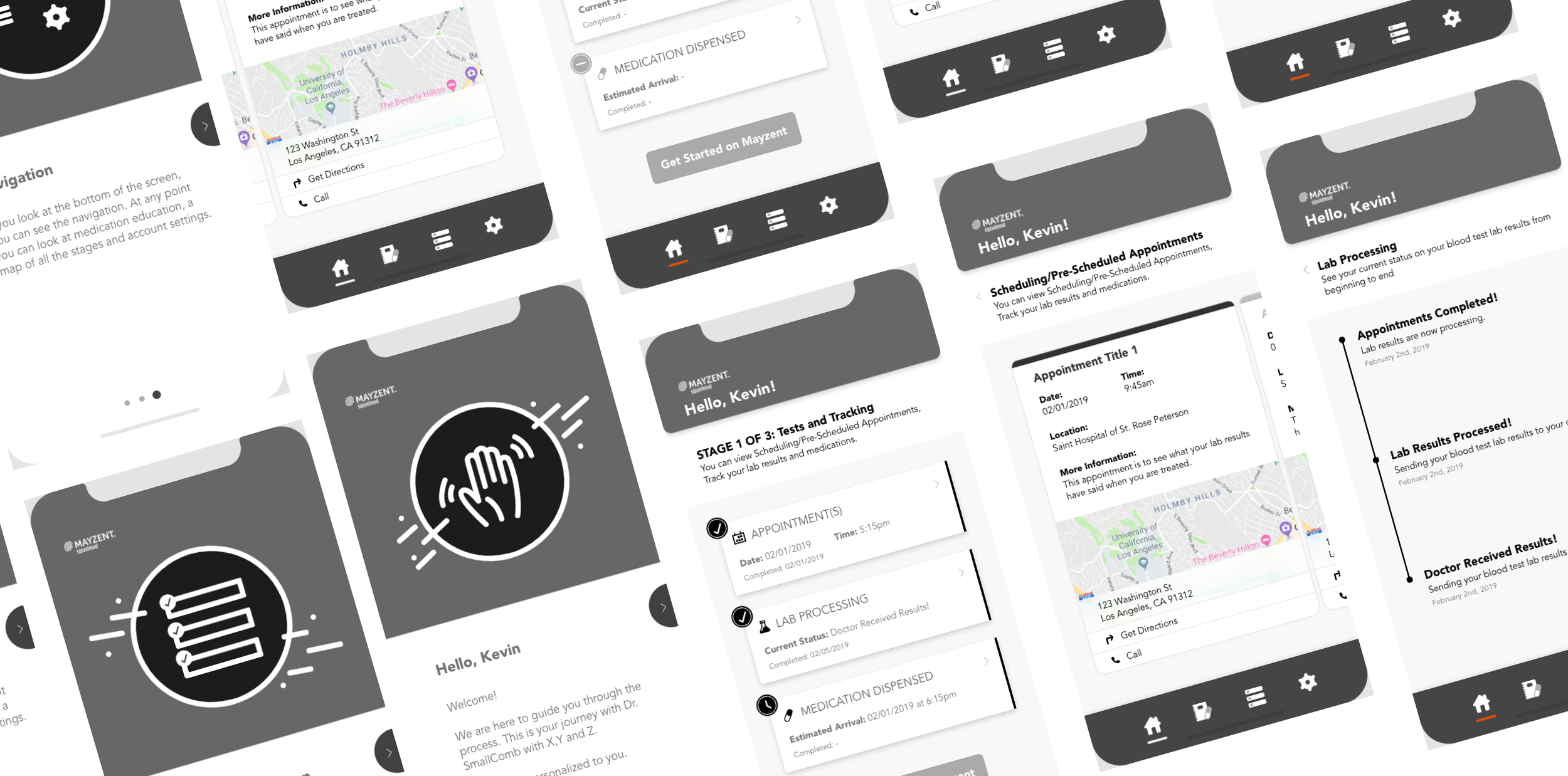
Low-fidelity wireframes for the Mayzent patient app, shown as tilted screen mockups covering onboarding, welcome, navigation guidance, appointment details with maps, lab processing status, and medication dispensing tracking.

The prototype

These interactive prototypes showcase the redesigned provider portal and patient mobile app.

  • Provider Portal: Streamlined patient onboarding and management workflows for healthcare providers.
  • Patient App: Simplified medication tracking, treatment guidance, and communication with care teams.
Provider Portal — onboarding a patient
Patient App — tracking treatment

~ Thanks for visiting — relax and move your cursor here before viewing the next case study ~